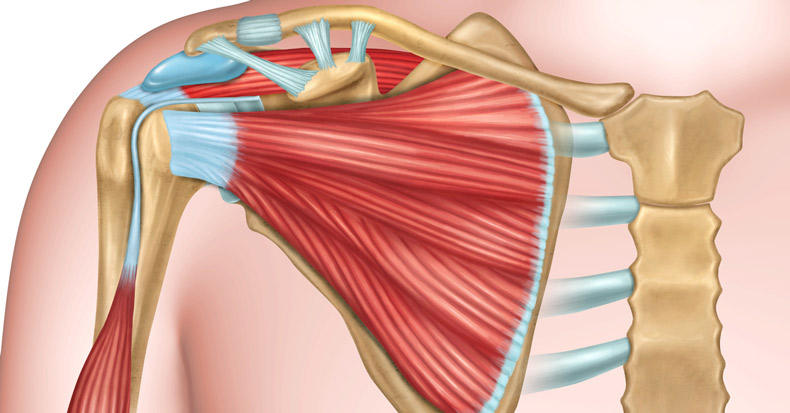
The shoulder is not a single joint. It’s a complex structure made up of four joints that must work together to allow the wide range of motion needed for everyday arm movements. While the glenohumeral (ball-and-socket) joint often gets the most attention when assessing the shoulder, the scapula—or shoulder blade—is frequently overlooked despite its important role in shoulder movement and stability. Let’s look at some of its key functions:
- Stable Base for Muscle Activation: The scapula provides a stable platform for the rotator cuff and surrounding shoulder muscles to function properly. This stability is essential for coordinated movement, efficient force production, and safe load transfer during arm activity.
- Scapulohumeral Rhythm and Joint Positioning: As the arm lifts, the scapula moves in coordination with the humerus to maintain proper alignment between the ball and socket. This coordinated motion—called scapulohumeral rhythm—includes upward rotation, posterior tilt, and external rotation. These movements help preserve space in the shoulder joint, reduce the risk of impingement, and allow for smooth, full-range motion.
- Kinetic Chain Function: The scapula acts as a link between the shoulder, neck, and trunk, helping transfer force from the core and lower body to the arm. This role is especially important during activities that require strength, coordination, or overhead motion.
- Glenohumeral Stability: The scapula must strike a balance between mobility and stability. It needs to move freely to position the socket correctly while also providing a firm base that allows the shoulder joint to remain stable during movement. This balance is critical for preventing injury and maintaining normal shoulder function.
Research shows that improving scapular muscle endurance and correcting abnormal scapular positioning—both at rest and during movement—through manual therapy and targeted exercises can lead to better outcomes in patients with shoulder pain, including impingement. Additionally, studies have linked poor scapular alignment with an increased risk of chronic neck pain as well as greater pain intensity and disability. For this reason, doctors of chiropractic often evaluate the scapula when assessing patients with shoulder or neck pain.