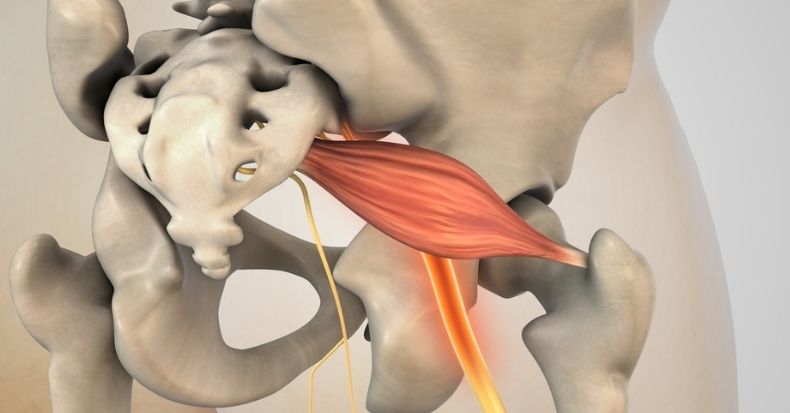
While a herniated disk is a well-known cause of sciatica—pain that travels from the lower back into the buttock or down the leg—it is not the only one. In some cases, a small muscle deep within the hip called the piriformis may contribute to similar symptoms. Understanding how this muscle functions can help explain why identifying the true source of radiating leg pain is sometimes complicated.
The piriformis is located beneath the larger muscles of the buttock. It stretches from the lower part of the spine and pelvis to the upper portion of the thigh bone. Although relatively small, it plays an important role in stabilizing the hip and pelvis and helping rotate the hip outward. These functions contribute to activities such as walking, climbing stairs, changing direction, and maintaining balance.
When the piriformis becomes tight, irritated, or does not function normally, it may affect the way the hip and pelvis move and contribute to pain in the buttock or surrounding areas. Just beneath the piriformis—or, in some people, passing through portions of the muscle—runs the sciatic nerve, which travels from the lower back into the leg. In some individuals, irritation or entrapment of the sciatic nerve near the piriformis may also produce pain, tingling, numbness, or aching that travels down the back of the leg.
A recent literature review concluded that piriformis syndrome is frequently overlooked because its symptoms can closely resemble conditions such as a lumbar disk injury or sacroiliac joint dysfunction. Some estimates suggest that piriformis syndrome may account for approximately 5% to 8% of cases involving low back, buttock, or leg pain, but diagnosing the condition remains challenging because there is no single test that confirms it. Instead, healthcare providers rely on a careful history and physical examination and, when necessary, imaging or other testing to evaluate alternative causes.
Because evaluating suspected piriformis involvement requires looking beyond the location of the pain itself, a chiropractor may assess hip mobility, muscle strength, flexibility, posture, walking mechanics, and tenderness around the hip and pelvis in patients presenting with lower back, buttock, or radiating leg pain. Specific examination procedures can help determine whether the piriformis may be involved while helping distinguish it from other possible causes, such as a lumbar disk problem or nerve compression in the spine.
When appropriate, conservative treatment by a doctor of chiropractic may include soft tissue techniques to reduce muscle tension, manual therapy to improve movement in the spine and pelvis, stretching and strengthening exercises, and guidance on activity modification—all with the goal of reducing pain, improving function, and promoting healthier movement patterns.