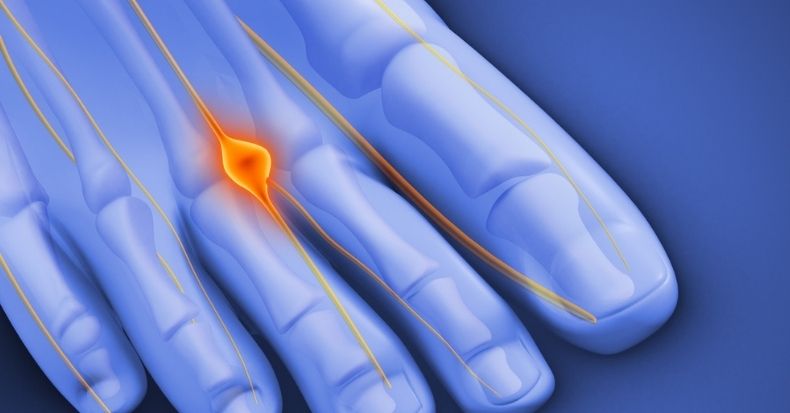
Morton’s neuroma is a common condition caused by irritation and thickening of a nerve that runs between the metatarsal bones, most often between the third and fourth toes. As the nerve becomes irritated, it can produce burning pain, numbness, tingling, or a feeling that there is a small object inside the shoe. Although the exact cause is not always clear, repeated stress on the forefoot, certain foot mechanics, and footwear choices may all contribute to the condition.
For people with Morton’s neuroma, walking or exercising may trigger pain, tingling, or the sensation of standing on a pebble. Although treatments such as shoe modifications, orthotics, and corticosteroid injections are commonly used, new research suggests that manual therapy directed at the joints of the toes may offer another conservative option for some patients.
In the study, researchers compared two treatment approaches in a randomized clinical trial involving 61 adults with Morton’s neuroma. One group received six weekly sessions of targeted manipulation of the metatarsophalangeal joints—the joints where the toes meet the foot. The other group received a corticosteroid injection, a commonly used treatment for the condition.
The patients treated with joint manipulation reported greater improvements than the injection group, including an 84% reduction in pain immediately after completing treatment and a 53% improvement in foot function, with benefits continuing through a one-year follow-up appointment. These findings suggest that joint-based manual therapy may offer a promising noninvasive treatment option for some patients with Morton’s neuroma. Improving the way the joints of the forefoot move may help reduce mechanical stress on the irritated nerve and support better function, although additional research is needed to better understand how the treatment works and which patients are most likely to benefit.
Chiropractors are trained to evaluate musculoskeletal conditions affecting the feet and lower extremities and can identify findings that may require referral to another healthcare provider when appropriate. For some patients, conservative chiropractic care may include manual therapy, recommendations for footwear or activity modification, and exercises designed to improve foot mechanics and mobility.