
Not everyone injured in a motor vehicle collision recovers completely. A percentage of those injured will suffer for years or sometimes even for decades. Documented examples of this chronic pain syndrome include: In 1964, the Journal of Bone and Joint Surgery (American) published a study where the author followed 145 whiplash-injured patients for more than […]
Search Results for: how to prevent whiplash
Low Impact Motor Vehicle Collisions And Whiplash Injury

It is clear that automobile accident insurance company claim adjusters, automobile accident insurance company defense attorneys, and defense medical/chiropractic experts believe that an individual in a vehicle involved in a collision cannot be injured if the vehicle sustains only minimum structural damage. Yet, there is no doubt that individuals involved in minimum structural damage collisions […]
Whiplash – Can We Predict Long-Term Problems?

Whiplash (or the rapid acceleration forwards followed by deceleration or sudden stopping of the moving head during the whiplash event) occurs at a speed that is so fast, we can’t prepare for it. In other words, by the time it takes us to voluntarily contract a muscle to guard ourselves against injury, that rapid forward/backwards […]
Whiplash Injury, Chronic Pain, Non-Pharmacologic Managements Adjuncts

Not everyone injured in a motor vehicle collision recovers completely. A percentage of those injured will suffer for years or sometimes even for decades. Documented examples of this chronic pain syndrome include: In 1964, the Journal of Bone and Joint Surgery (American) published a study where the author followed 145 whiplash-injured patients for more than […]
Whiplash Avoidance (…continued)

Last month, we discussed car safety features, proper headrest position, how to prepare for a crash, and to seek immediate treatment as ways to minimize the chances of suffering from whiplash in the event of an accident. Here are four more ways to avoid or minimize whiplash:
Whiplash Avoidance

Whiplash, or more properly stated, Whiplash Associated Disorders (WAD), is usually associated with car accidents, slip and falls, and sports injuries. It is a very common injury affecting millions of people around the world, and costing health care systems billions of dollars. The question of the month is, what can we do to AVOID or […]
Common Whiplash Myths – Part 2

Last month, we began discussing common myths about whiplash injuries, and this month, we will continue on that course. Remember, the amount of injury that occurs in an acceleration/deceleration injury is dependent on many factors, some of which include gender (females>males), body type (tall slender = worse), the amount of vehicular damage (less is sometimes worse as the energy of the strike was not absorbed by crushing metal), head position at the time of impact (rotation is worse than looking straight ahead), and more. Therefore, each case MUST be looked at on its own merits, not just analyzed based on a formula or accident reconstruction.
Whiplash – Biomechanics and Costs
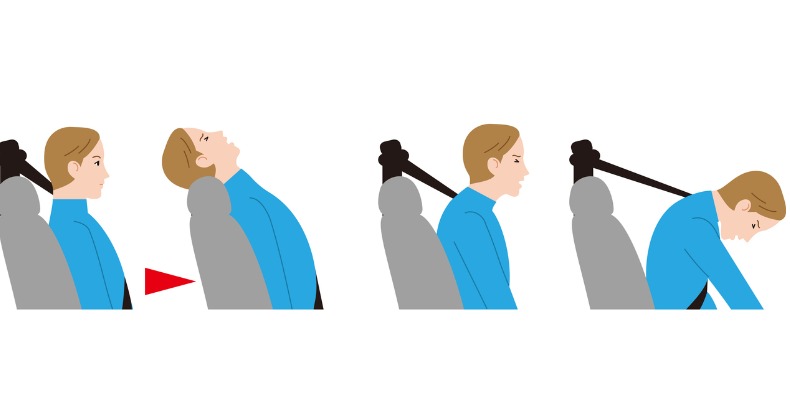
Whiplash or cervical acceleration-deceleration disorder (CAD) is primarily associated with motor vehicle collisions (MVCs) and in particular, rear-end collisions. Last month, we discussed how CAD can be prevented and focused greatly on paying attention while driving and the position of the headrest. Whiplash is defined as an injury to the cervical spine (neck) caused by […]
Whiplash – The Importance of Seatbelts!

Whiplash is a very common problem afflicting millions of people every year. In fact, there are more than 6 million car accidents each year in the United States alone. Death associated with car accidents occurs every 12 minutes and each year, motor vehicle collisions (MVC) kill 40,000 people. For people between 2 and 34 years […]
Whiplash – Cell Phones & Other Driving Distractions!

Whiplash is caused by a sudden movement of the head, usually during a motor vehicle collision (MVC) but it can also occur during sports-related activities and from slip and fall injuries. The combination of the weight of the head (approximately 15 lbs or 7.8 kg) and the length and strength of the neck predisposes the […]
- « Previous Page
- 1
- …
- 3
- 4
- 5
- 6
- 7
- …
- 11
- Next Page »