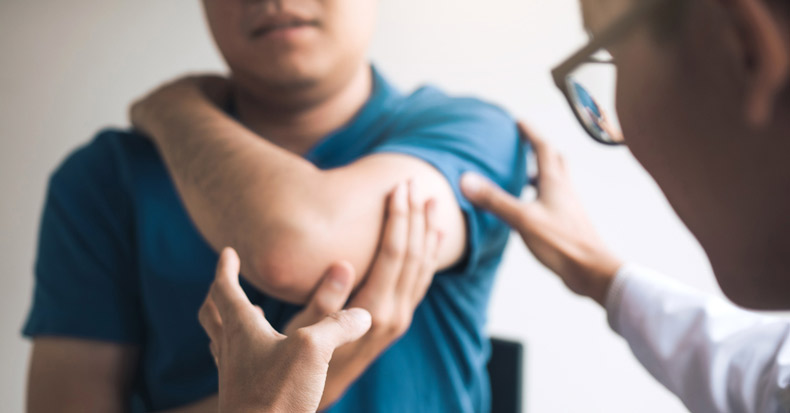
Tennis elbow, also known as lateral elbow tendinopathy, is a common condition involving irritation of the tendons that attach to the outside of the elbow. Despite its name, it affects many people who have never played tennis. Repetitive gripping, lifting, typing, and tool use can all contribute to the condition. Traditionally, treatment has focused on the elbow, forearm, and wrist. However, growing evidence suggests the shoulder may also play an important role.
One reason involves the concept of the kinetic chain. When reaching, lifting, throwing, gripping, or performing other arm movements, force is transferred through a connected system that includes the shoulder blade (scapula), shoulder, elbow, wrist, and hand. If the muscles around the shoulder and shoulder blade are weak, the body may compensate by placing greater demands on the forearm muscles that attach to the elbow. As a result, the wrist extensor tendons may work harder, increasing stress on already irritated tissues and reducing opportunities for recovery.
The shoulder blade serves as the foundation for arm movement. Several muscles help stabilize and control its position, including the lower and middle trapezius, serratus anterior, and rhomboids. Weakness in these muscles can contribute to poor shoulder positioning and less efficient movement patterns throughout the arm. When the scapula is more stable, the arm can move more efficiently and less force may be transferred to the elbow.
The rotator cuff muscles are also important because they help stabilize the shoulder joint during movement. If these muscles are weak, larger muscles may compensate, making movement less efficient and potentially increasing stress farther down the arm. Improving rotator cuff strength may help distribute forces more effectively, reduce excessive gripping, and decrease repetitive loading of the wrist extensor tendons.
Many people with tennis elbow have reduced grip strength because gripping increases tension on the irritated tendons. Interestingly, grip strength often improves when shoulder and scapular exercises are included in rehabilitation programs. Better shoulder function can make the entire arm more mechanically efficient, reduce protective muscle guarding, and decrease irritation of the painful tendon. Better shoulder mechanics can reduce tendon stress, improved muscle endurance can distribute workload across the entire arm, and exercise can enhance motor control and influence how the nervous system processes pain signals.
Rather than viewing tennis elbow as an isolated elbow condition, many researchers now recognize the important role that shoulder and scapular function can play in both the development and persistence of symptoms. A chiropractic evaluation may help identify contributing factors involving the shoulder, elbow, and surrounding structures. Chiropractors are trained to evaluate musculoskeletal conditions, recognize findings that may require referral, and provide conservative care when appropriate. Depending on the individual, treatment may include exercise recommendations, manual therapies, activity modification, and other conservative approaches designed to improve function and support recovery.